In this section I will include material that was not included or was greatly reduced in the text. That may have been done due to the appropriateness of the topic in the context of the book.
METALS AND ALCHEMY
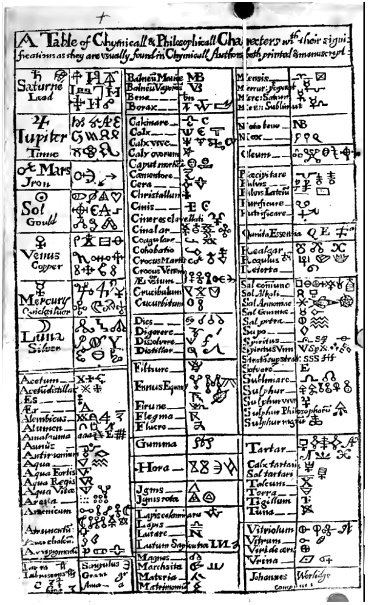
Alchemy notes by Basil Valentine (Valentine, 1671)
Metals
Every metal on our planet has its own essence, nature, and pattern. According to Astrology, each one corresponds to the essential nature of a particular planet in our Universe. The vibrations from the planet are attracted and reflected by the metal associated with it. The use of a metal by man also tends to be along the lines of the planet’s own nature as reflected by the human character. (Ulydert, 1980).
Some say that metals are the gifts from the heavens, sent by the Sun, stars, and planets (Ulydert). As poetic as this may sound, it is true: metals were part of that giant dust ball that came from a supernova long ago that formed our solar system. Her whole body is permeated by veins of metal and metal ores. These veins conduct energy through the Earth’s tissues of rock and form the Earth’s nervous system (Ulydert).
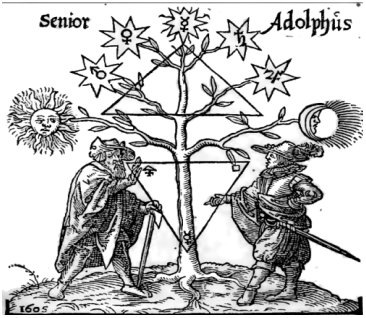
Tree of the Metals (Bringern, 1613)
A metal can be shaped by forges and furnaces great and small but it still retains its essence and the energies particular to that metal (Ulydert). Metals build our bodies. They are in our bones, our tissues, our blood, and other bodily fluids. All metals are potent healing/magical tools and their use is nearly as old as the human race (Cunningham, 1990). From the beginning of time we humans have noticed and used the metals that cross our paths.
Noble Metals
Undoubtedly, the first metals used by humans were the so-called “noble metals:” Copper, Silver, and Gold. These metals are little-affected by the environment and could, at one time, be found all over the surface of the Earth. They were found in lumps that could be picked-up off the ground. One very large piece, a giant Copper nugget, was found in Michigan. It had marks on its surface from where the locals hacked-off pieces with their stone tools (Venetsky, 1981). Now most of these easy-to-get metals have been already gotten, so they are not so easy-to-get anymore.
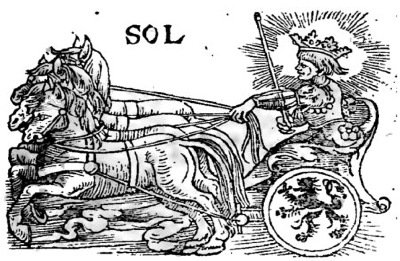
Gold the Metal of the Sun and Kings (Hygini, 1535)
Gold
“The yellow metal that makes white man crazy” (Black Elk in Neihardt, 1988).
One day, one of our ancestors was grubbing in the alluvial deposits of a stream looking for food, when he or she found a glittery yellow stone. That lucky person had one of four choices: (a) give it to a prospective or potential mate to gain favor (sex or a strong mate) much like the (male) penguins of Antarctica who present a rock to the female or the bowerbirds of Australia and New Guinea who present gifts and great displays for their prospective mates; (b) figure out how to string it and wear it proudly around her or his neck until such time that she or he got killed for it by some covetous person; (c) show it to the shaman who would certainly know what to do with it (probably adorn himself or his mate); or (d) say nothing, either leave it there or keep it a secret, sort of like the “hidden immunity idol” on the television program Survivor. Well, probably all the above occurred but I would suspect that (a), (b), or (c) were the favored choices. Soon, all the other members of the extended family group set out on their own to find yellow rocks of their own to gain favor with the gods or girls (or boys). Perhaps this is the first time, “There’s Gold in them thar hills!” was uttered? I am not an anthropologist but soon great civilizations sprang up, the big ones were all interested in Gold for gods, adornments, and sex.
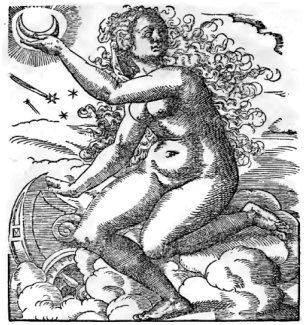
Luna - Silver (Jost, 1599)
Silver and Copper
Silver and Copper were found in lumps Gold but they would not have glittered. Being “lesser” metals, they are tarnished where Gold, the most noble metal, did not. They both were fairly malleable but hardened when pounded into shape. Copper tools are among those found in excavations of early humans. They may have been suitable for weapon points. Maybe there was an early Homo Sapiens Sapiens Lone Ranger who traveled with his trusted friend, Tonto and rode an equid named Argentum. The Lone Ranger and Tonto ride off into the sunset, “Hi-yo Argentum, away!” A man and his son watch as they ride away. “Grot, who was that masked Homo Sapiens Sapiens?” Young Grot replies, “I don’t know, but he left a Silver atlatl point behind.” (The atlatl is the predecessor of the bow and arrow.)
Evidence of ancient Copper smelting was discovered in Turkish ruins dating from 6500 BCE. The ability to work Copper by softening it over a fire and hardening it by pounding produced favorable properties so that it started replacing stone tools (Venetsky). Tools of Copper were used to carve the stones that made the pyramids of Egypt (Venetsky). A less poetic discovery of the metals may have also occurred for some. The nuggets of Copper, Silver, and Gold, were probably treated like stone and were chipped, battered, abraded, and finally polished (Hough, 1922). Only then would the beauty of the metal piece be appreciated. Silver and Copper were plentiful in the North American southwest. Copper and Silver jewelry was and is made worldwide by traditional peoples, including Native Americans.
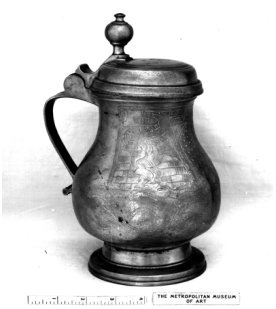
Pewter Flagon [with a Dragon?] (Metropolitan Museum of Art, 1700s)
Other Metals
One day, a hunting party wandered into an unfamiliar place in low hills eroded by millennia of wind and rain. The rocks from which they made their fire pits seemed black and heavier than the ones they were accustomed to. After the fires got hot, silvery water leaked from the fire pits and after a time froze into a hard silvery ice. This ice could be bent and formed but was too soft for spear points but it made nice plates and bowls. Thus the first pewter dinnerware was invented. As humans continued to evolve, hotter and hotter fires were made and one day yellow water leaked from the rocks which froze. This yellow water looked like Gold but where Gold was soft, this new metal was hard and could be fashioned into spear points and knives. It was harder than Copper and not lustrous as Gold: but much more practical for making weapons. Eventually, primitive humans learned to melt and cast these alloys of Copper: brass and bronze. They became the most important material for tools and weapons from about the fourth century to the first century BCE (Venetsky, 1981). From the mate to the shaman to the armorer to the alchemist to the chemist and finally to the metallurgist, our species found, dug, smelted, and melted our Earth’s bounty to create the wonderful substances we know as metals. However, except for the shamans and perhaps some alchemists, we know almost nothing about metals as living substances.
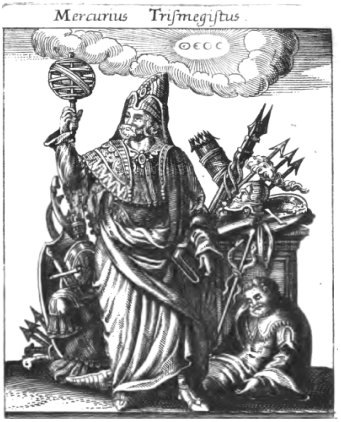
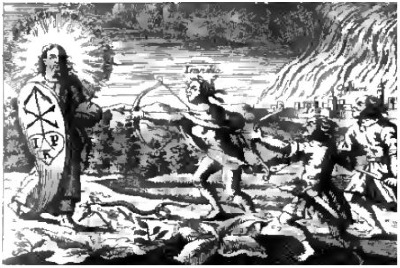
Hermes Thrice Great (Mussard, 1675)
Alchemy
Alchemy holds the secret of making Gold from another metal, creating a universal medicine for the cure of all diseases, and the freedom from death by the extension of life indefinitely (Boerhaave, 1727). The alchemists claim ancestry back to Adam (of the Christian Old Testament). The ability to make Gold was supposedly lost in Noah’s flood but restored by Moses (Boerhaave). A legendary ancient king of Egypt called Hermes (he may have been a god or god-human creature), later given the title Hermes Trismegistus (thrice great) became the “modern” focal point of the alchemical or “Hermetic” tradition. After the fall of Rome around 500 CE, the secret Hermetic teachings stayed in the Middle East (specifically Iraq and Iran) until they were brought to Europe. When they reappeared in Europe, they came with a new name, “Alchemy” a combination of two words “Al” to honor Allah and “chemia” the Egyptian word for chemistry, but meaning the study of mixtures. Arthur Waite, author of Lives of the Alchemystical Philosophers (1888,) claims that around 700 CE Abou Moussah Djafar al Sofi, known as the alchemist Gerber brought his knowledge of alchemy and chemistry to Europe. Waite lists Rhasis (Persian, 850 CE), Alfarabi (Persian, 950 CE), Avicenna (Persian 1000 CE), and Morien (Alexandria, 1100 CE) before talking of the European alchemists. The significant European adepts were, Albertus Magnus (1200 CE), Thomas Aquinas, Roger Bachon (1200 CE), and Alain of Lisle (Paris, 1278 CE). Nicolas Flamel practiced in the late 1300’s (Waite). The Mirror of Alchimy was written by Roger Bachon and published in London during 1597. Here Bachon defines alchemy (there are no misspells or typos here, that’s how he wrote it): “In many ancient Bookes there are found many definitions of this Art, the intentions whereof we muſt [the funny letter “ſ” is a Latin “s” and is read as such] consider in this Chapter. For Hermes ſaith of this Science; Alchimy is a Corporal Science ſimply compoſed of one and by one, naturally conioyning things more precious, by knowledge and effeƈt [another of those funny letters], and conuerting them by natruall commixtion into a better kind. A certain other ſaith: Alchimy is a Science, teaching how to transforme any kind of mettall into another: and that by a proper medicine, as it appeareth by many Philoſophers Bookes. Alchimy therefore is a ſcience teaching how to make a compound a certain medicine, which is called Elixir the which when it is caſt ypon metals or imperfeƈt bodies, doth fully perfeƈt them in the verieproieƈtion.
That being said, I am sure you have a full understanding of alchemy. Alchemy was a pseudo science that preceded Chemistry. Participants were always trying to convert “baſer metallſ” (sorry) into Gold and to create the Elixir of Life and the Philoſopher’s Stone. Creating Gold from baser metals (Lead, for instance) was quite impossible using Medieval Chemistry techniques and equipment, but some of these people, Bachon among them, helped to bring about the new science of Chemistry. Nicolas Flamel said that Alchemy is a science whose successful practice required the knowledge of the four elements of the philosophers. These four elements were not the standard Earth, Air, Fire, and Water that we usually attribute to Alchemy (Flamel, 1628).
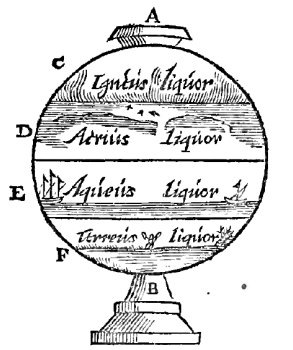
Earth, Water, Air, & Fire (Kircheri, 1662)
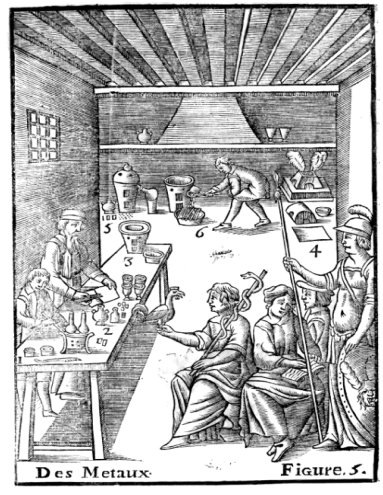
He did not divulge the elements to which HE was referring. Thomas Norton, a 15th century Alchemist said, “Alchemy is a wonderful science, a secret philosophy, a singular grace, and free gift of the Almighty” (Waite, 1888). Early Alchemists had sanction from the Church (Roman Catholic) and Bachon, Aquinas and St. Basil were members of the Church. Several Popes were adepts. A “successful” Alchemist would always have to watch his/her back for fear of someone trying to rob or torture him or her to gain his secret. Since they could not really make Gold they were killed when their fraud was discovered. Many Alchemists, like Flamel, went into hiding to avoid prosecution or torture. Other Alchemists died slow and painful deaths due to metal poisoning from all the vapors they inhaled, especially Mercury and Lead. Stearns writes in American Oracle (1791), Earth consists of vegetables, animals, and metals along with an inert substance called Caput Mortuum, (literal translation, “dead head,” years before Jerry Garcia) that I will venture a guess as plain rock. Air is a transparent atmospheric fluid substance that includes plain air, inflammable air (gasses), poysonous aire, and a multitude of vapors and gasses given off during heating, reacting, and diſtillation. Fire is not just the flame that comes from burning a substance but it is of great importance to cookery and Chemistry. It is the heat that is in all living bodies without which we cannot exist. When an animal loses its heat, it becomes a cold, lifeless lump (Stearns). Animal heat is produced by the “crassanentum” of the blood which attracts and retains a part of the fire which is dispersed throughout the terraqueous globe (Stearns). It gives motion to the particles of air. Water encompasses all the liquid substances. Most Water is combined and contaminated with other Water and with Air and Earth (Stearns). Water is of great service in navigation, chemistry, cookery, and is good to drink (Stearns). Each metal has properties of the four elements: The ore of the metal is from the Earth: the “Refiner’s Fire” (thank you Handel) heats the metal so it can be purified, cast, and forged; Air from the bellows allows the fire to burn fiercely. Water is used to cool the metal; with steel, the cooling rate is critical. The planets likewise give rise to the energetic power of a metal. Gerber (in Waite, 1888) wrote of the association of Lead with Saturn, Tin with Jupiter, Iron and Steel (Steel is mostly Iron) with Mars, Copper with Venus, Mercury with… you got it Mercury, Silver with the Moon, and Gold with the Sun (Cunningham, 1990).
Alchemy, Astrology, and shamanism have been largely discredited as superstitions. In Alchemy’s case, the scientific stuff went to chemistry and the other stuff was relegated to the mystery of the ancients, to fiction books, and of course to Harry Potter (Rowling, 1998). In the first book, Harry encounters, “The Sorcerer’s Stone” created by none other than Nicolas Flamel who is still alive and kicking at Hogwarts Academy in the 20th century. His wife Perenelle, allegedly
Nicolas Flamel (Flamel, 1751)
predeceased him and he died on March 22, 1418. Waite (1888) recounts stories of both Flamels being still alive in the 18th century, why not still alive for Harry Potter. Perhaps he’s out there still?
Physical sensations from metals.
Metals should not produce a physical sensation… but they do. About one-in-five people whom I have queried over the years receive physical sensations from quartz, some minerals, and some metals. Not everyone feels all the same minerals or metals as everyone else. We feel them, just not the same ones. So why do metals (and others) produce physical sensations? I believe there are several factors that when combined produce the effects. Metals reflect radio waves and we are being constantly bombarded by radio and micro waves. We may be feeling the reflection of these waves off of metals into our sensitive bodies. Metals are good electrical conductors. Whenever a magnetic fields is pulsed by a conductor, electrical current is produced. Our bodies produce extremely low frequency magnetic fields, which when impinged on a conductor creates electrical currents. Therefore, we could also be sensing the current we generate by our own magnetic fields. This is roughly how magnetic field detectors and metal detectors work.
Alchemy and Metals for Healing.
A Master Teaching Healing Properties of Metal (Barlet, 1653)
While alchemy failed to make Gold from Lead, there is physical evidence that metals studied by Alchemists could have been used in therapeutic environments. Metals are ideal for therapy because they are highly reactive, many of them reactive to tissues and fluids; they make a variety of chemical compounds; and the compounds they make have complex three-dimensional structures that can interact with the molecular bonding sites of cells (Frezza, 2010). Metal and metal compound interactions with bacteria and viruses can interrupt the virus/bacteria influences on healthy cells. Metal is carried in pockets, hung around necks, put into water to make elixirs for drinking, shaved and eaten whole, or injected into our bodies. When worn next to the skin, metal atoms and ions are absorbed directly by the skin’s pores. The change in metal concentration in the blood stream when someone wears a Copper bracelet, for instance, is measurable. Historically, metals and metal alloys or metal salts (bonds between metal and non-metal, sort of like… table salt, a bond between a metal, Sodium and a non-metal, Chlorine) have been used for many purposes, two of which stood out from the literature were the treatment of arthritis and the treatment of venereal diseases. Gold salts are still in use today for the treatment of rheumatoid arthritis. Their popularity has waned a bit because of the side effects of treatment, but some people still receive “Gold” injections. Apparently, syphilis was very common during the time of our ancestors. The old medical books that I have perused in search of information, revealed many, many metal compounds for treating venereal disease: from Mercury to Gold. Metallotherapy for venereal diseases diminished nearly into oblivion with the development of antibiotics (Lemire, 2013) although even in modern times, Silver compounds were used in newborn babies’ eyes to counter venereal diſeaſes. The growing list of antibiotic resistant bacteria has caused a resurgence of metal therapies (Palanisamy, 2014 and Lemire). Silver compounds are once again being used to fight infection in hard-to-treat wounds. Cisplatin, a metal compound containing Platinum has (as previously stated) been called the “penicillin of cancer treatments.” Yttrium, isotope 90 is a radioactive rare earth metal that has been found to reduce tumor sizes in liver cancer. Micro spheres of Yttrium-90 (Y-90) are injected into the primary blood source of the liver. These Y-90 microspheres become lodged in tumors. The energetic Beta particles produced during radioactive decay of Y-90 kill tumor cells (Advances in Yttrium-90). Yttrium-90 is a waste product of Uranium and is produced in nuclear reactors as Strontium-90 which decays into Y-90 (Wikipedia).
Some Selected Metals
There are 80 or so metals or metal-like atoms within the crust of the Earth and on its surface. There are perhaps a zillion alloys of these metals. Since I am trying to illustrate the therapeutic properties of metals, I will concentrate on five metals to demonstrate my thesis.
Gold
Gold (Aurum) is a perfect body, engendered of Argent-vivre. It is pure, fixed, clear, and free of Sulfur. It wanteth nothing (Bachon, 1597). Gold contained the pure Argent-vivre, sometimes called “Silver” and sometimes referred to as the Prima Materia, Mercury. (One of the many criticisms of Alchemy is that there is no consistency from person to person and even within the ramblings writings of the same person contradictions abound.) Gold takes the energy from the Sun, in fact Gold is the Sun’s energy, given substance (Pomet, 1737). The King’s crown must be made of Gold because it is a symbol of the Sun’s energy descending upon the King/Queen, and thus blessing the whole kingdom (Uyldert, 1980). The ruler becomes highly charged with the power of the Sun (Uyldert). Turning that into a more Judeo-Christian perspective, the King’s crown is made of the metal of God, giving the King divine sanction and power to rule God’s kingdom here on Earth. Gold unites Earth’s forces and energies, signified by its precious stones in the crown jewels, with that of the Sun, making a perfect marriage between Heaven and Earth (Uyldert). It is present in religious sanctuaries and holy places which became “power stations” for the faithful, giving routine recharging and energy to carry on in the name of the deity (Uyldert). It is a Fire element that raises the energy of its wearer (Cunningham, 1990). It brings healing, wisdom, success, wealth and protection (Cunningham). Gold was used commonly for depression, suicide, and syphilis. It was used to cure “women’s diseases” and by rubbing it on your body it gave you energy and vitality (Uyldert). Homeopathically it is used in its compounds with Mercury, Sulfur, Arsenic, and Bromine to cure Parkinson’s Disease, pneumonia, and headaches. It is used for Multiple Sclerosis, warts, genital warts, and cancer. Injections of Gold salts, as previously mentioned, are used in the treatment of rheumatoid arthritis. Even in the early days of medicine, Gold foil was used in dentistry (Pereira, 1846). It promoted secretions of the skin, and activity of the salivary glands and the kidneys (Pereira). As with most metals, too much Gold is toxic to the body. Its toxicity to body tissues has helped Gold and other metals, particularly Platinum, to enter the arena as potential cancer medications.
Silver
Silver is a Water element that brings love, psychism, peace, wealth, and protection (Cunningham 1990). Those who wear Silver, receive the power of the full Moon giving psychic awareness and the ability to scry (e.g. mirror gazing, crystal ball gazing, and water gazing techniques similar to those used by Nostradamus). Silver provides protection by reflecting negativity from the wearer (Cunningham). Its feminine charms are clean, pure, and almost perfect, begotten of Argent-vivre (Bachon, 1597). Silver loves Sulfur. Argentum is its Latin name, showing how closely it is associated with Argent-vivre. Silver is the best conductor of heat and electricity and rings with a pure sound. It was used of old as treatment for diseases of the head and brain (Pomet, 1737). Migraine headaches, diabetes, gastritis, epilepsy, pleurisy, and fertility problems… oh and did I forget… syphilis were all treated with Silver. Silver foil and amalgams of Silver (Silver dissolved by Mercury) were used to fill dental cavities (Pereira, 1846) up to modern times. Vessels of Silver and Copper preserved water and food (Lemire, 2013). Silver coins were placed in water, milk, and vinegar to prevent the spread of dysentery. During World War II, Japanese soldiers used Silver coins in canteens to purify the water (Lemire). Alexander the Great’s army stopped because of disease among the soldiers. The officers were not likewise affected. Soldiers drank water from Tin cups: officers, Silver. The officers did not get sick from the water where the soldiers did (Venetsky, 1981). Using Silver nitrate in the eyes of newborn babies dramatically reduced the syphilis infection rates in newborns (Lemire). It is used to coat catheters. Silver salts were used to treat leprosy, tuberculosis, and did I mention, gonorrhea and syphilis (Lemire). Stitches of Silver wire were used on women after childbirth. A while ago, I purchased a pair of socks that supposedly had Silver threads woven into the material to prevent my feet from stinking because of Silver’s antibacterial properties. I don’t remember if it worked or not. Silver nano-particles (10-9 meters in size) not only provide antimicrobial properties but experiments are being performed on their efficacy for the HIV, hepatitis B, and herpes simplex (Galdiero, 2011). The country Nubia was named for its Gold, a large supplier to Egypt (“Nub” is Egyptian for Gold), Argentina was named for its Silver (Argentum) (Venetsky, 1981). In “modern” lore, vampires and werewolves are easily dispatched by a bit of Silver. Perhaps it is Silver’s affinity for the Moon is why it kills werewolves, as far as vampires, it’s anybody’s guess.
Mercury
“Among the numerous poisons which have been used for the cure or alleviation of disease, there are few which possess more active and of course, more dangerous powers than Mercury” (Mosher, 1846). Mercury is another ancient metal although it hardly seems metallic because it is liquid at room temperature. Its most common ore is Cinnabar, a bright red Sulfur compound of Mercury which looks like blood and probably brought its attention to the ancients. Rocks with cinnabar look like they have blood spots or spatters on them. Pure Mercury is easily obtained by heating cinnabar, releasing the Sulfur from the metal ore. It was given its Latin name, Hydrargyrum, combining the Latin names for water and Silver. In Rome, the metal was given the name “Mercury” after their god of speed and the god ruling the planet Mercury. Mercury belongs to all of the four elements: it is heavy so it is of Earth; it is liquid, so it is of Water, it is of Air because Mercury is often used in vapor form (Cunningham, 1990) and it is of Fire because, knowing that the heat from the fire melts metals, the ancients thought Mercury had an “internal flame” to keep it liquid (Uyldert 1980). Worn as a talisman, Mercury protects and helps one win at gambling (Cunningham). Mercury was the basis of all the metals partly because all except Iron, all metals dissolved in it. Since an ice cube dissolves into liquid water and an ice cube is made of water, then Gold dissolves into Mercury so Gold must be made of Mercury (Venetsky 1981). Thus to some Alchemists, it was the Argent-vivre, out of which all metals were created and out of which precious metals could be obtained. All one had to do was to treat Mercury in the proper way and it would yield the precious metals, especially Gold. A more sublime treatment of Mercury, in proper combination of Sulfur and other compounds, and giving it the proper respect and reverence, created the Philosopher’s Stone. In medicine, Mercury was used to cure strictures and obstructions of the bowels (Cullen, 1789) and to kill worms in the bowel (Pomet, 1737). In its pure form, Mercury was thought to not interact with the body so it could be taken by the mouth or freely handled without ill effect. One doctor wrote of a patient who took two pounds of Mercury per day for his bowel obstructions for a considerable length of time without any ill effects (Pereira, 1846). It was thought that as the Mercury traveled through the digestive system it smoothed the kinks and twists in the intestines (Venetsky). (It seems to me if a person had to drink two pounds of Mercury for any length of time, the Mercury wasn’t curing a thing.) One author agrees with me, stating that he never saw pure Mercury cure any diſeaſe (Cullen, 1789). Mercury only works when it has been “activated” so that it interacts with the body. This activated Mercury was found in its vapor form, as a “calcination,” or after it was combined with acids (Cullen). Thus treated, “the chief effeƈts of mercurial medications are to be aſcribed to their general ſtimulus of the ſyſtem and eſpecially to their ſtimulating the various excretories of it” (Cullen). Once activated, Mercury preparations were disinfectants, purgatives, diuretics, used to treat tonsillitis and ear infections, and used to treat venereal diſeaſe (Cullen, Venetsky, Ulydert). Its vapors have long been known to be poisonous and fumigation was originally thought to have been derived from a process where fumes of cinnabar were used to kill lice and other insects, disinfect sores, and to treat… venereal diseases (Pomet). For some medical people, “the whole extent of both theory and practise [sic] is to give calomel [mercuric chloride], if that will not help, give more calomel, and if that again prove abortive, double, treble the dose of calomel. If the patient recovers, calomel has cured him. If he dies, nothing on Earth could have saved him (Mosher, 1846). Mercury was also used in Silver amalgams, as previously mentioned, for dental work. Dental amalgam releases low levels of Mercury vapor that can be inhaled. High levels of Mercury vapor exposure are associated with adverse effects in the brain and the kidneys. The United States Food and Drug Administration (FDA), has reviewed the best available scientific evidence to determine whether the low levels of Mercury vapor associated with dental amalgam fillings are a cause for concern. Based on this evidence, FDA considers dental amalgam fillings safe for adults and children ages 6 and above. The amount of Mercury measured in the bodies of people with dental amalgam fillings is well below levels associated with adverse health effects. Even in adults and children ages 6 and above who have fifteen or more amalgam surfaces, Mercury exposure due to dental amalgam fillings has been found to be far below the lowest levels associated with harm. Clinical studies in adults and children ages 6 and above have also found no link between dental amalgam fillings and health problems. (About Dental Amalgam Fillings, 2014)
When I was a kid, a common product called “mercurochrome,” a bright red liquid, (the red came from its mineral heritage, cinnabar) was used by mothers throughout the land as a topical antiseptic. My mother preferred tincture of iodine (ethanol, pure iodine, and iodine salts) and I envied my friends whose mothers used mercurochrome because it looked cool. Mercurochrome was removed from the druggist’s shelves because some time between when I was a kid and when I became an adult, the world recognized that Mercury is not particularly safe, in fact, it is quite toxic. Mercurochrome was banned in 1998 as a toxic substance with “untested” efficacy (Lippert, 2013). I still like the color. Mercurochrome has since been re-introduced, without the Mercury.
Mercury has gone from a household item to an Environmental Protection Agency (EPA) hazardous materials threat.
Copper
Copper is the metal of Venus and gets its energy from the fourth element, Water. It helps direct energy, healing, luck, love, and wealth (Cunningham, 1989). Copper coins were used by pregnant women to help reduce or prevent morning sickness. It helps to stimulate healing and reduce energy blockages (Cunningham). Copper radiates friendship and benevolence, the love of life given to it by Venus. Copper is supposed to be used-up during love-making so lovers need to supplement their intake of Copper (Ulydert).
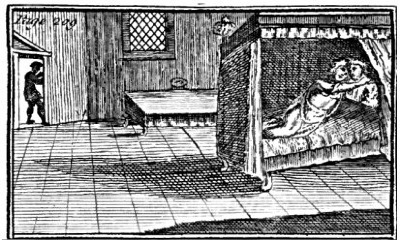
The Merchant and His Wife (Bidpa’i, 1789)
From an Alchemy point of view, Copper is unclean and imperfect (Bachon, 1597). Early Nepalese used Copper to aid in digestion and to increase mental concentration (Venetsky, 1981). Copper compounds were used in medicine for epilepsy, as an antispasmodic, for skin ulcers (treatment by Copper was superseded by Mercury compounds), for bruising, emphysema, flu, hernia, gout, and scarlet fever (Pereira, 1846; Cullen, 1789; Ulydert, 1981; Pomet, 1737). The “Smith Papyrus,” a medical text dating from 2600 to 2200 BCE, shows Copper was used for infected wounds. Compounds of Copper were used to treat leprosy, tuberculosis, and… you guessed it… venereal diseases (Lemire, 2013). Metallic Copper worn on the skin has been used for centuries to relieve joint pain and discomfort. This dates back to the ancient Greek period (Leong, 2008). Modern studies do not show clear beneficial effects of Copper jewelry. Copper is the second-most conductive pure metal, following Silver. Energetically, pure Silver and Copper are very efficient and allow electrical energy to pass with little resistance. They are 103% and 100% on the International Annealed Copper Standard rating. Aluminum alloys have barely 50% of Copper’s conductivity. Various brasses (alloys of Copper and Zinc) vary from 25 to 50% IACS (Aluminum and Copper, 2005).
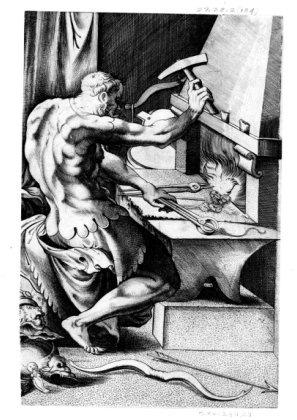
Vulcan Works His Forge (Vico, 1543)
Iron
Iron gets its character from the element, Fire. It has Mars energy which brings the love of the physical and greed (Ulydert). Iron brings protection, strength, and grounding. Practitioners of magic avoid wearing Iron and using Iron utensils when performing ceremonies (Cunningham). Because Iron does not appear in its metallic form in nature, it must be purified. Bachon says it is unclean and imperfect because of this (Bachon, 1597). The Hittite civilization is credited for the first Iron making around 2000 BCE (Venetsky 1981). Steel is a purified form of Iron and Bachon holds it in higher regard. “Steele is a body clean, imperfect. It wanteth only decoration” (Bachon). Iron weapons used by ancient civilizations came from meteorites, giving them mystical power. It is said that Charlemagne’s sword was meteoric. (Europeans didn’t believe in meteorites until someone in the Church said it was OK to do so, some time in the early 1800s.) Steel and Iron filings remove stomach and intestinal obstructions (Pomet, 1737). It is used for jaundice, diseases of the spleen, ulcers, and gout (Pomet). It eases symptoms of anemia, colic, and headache and eliminates flatulence (Ulydert). When making steel weapons and tools, these tools are cooled or “quenched” in water to improve their hardness. This quench water was a good precautionary medicine against “looseness,” ringworm, and sores. As far as I can tell treatments of Iron or steel were NEVER used to cure venereal diſeaſes.
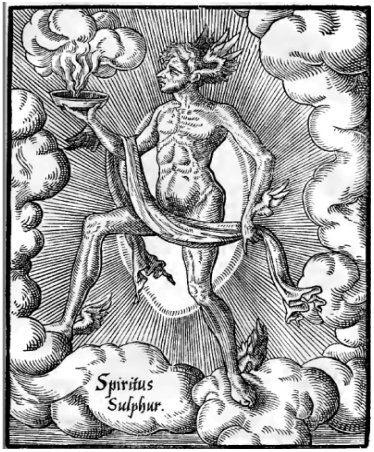
Sulfur (Thurneisser zum Thurn, 1574)
Sulfur
Sulfur is not a metal but was very important to Alchemy. It is a Fire element. It is found in the mines under very different forms; sometimes smooth and yellow, sometimes transparent yellow, and sometimes ruby red (Boerhaave, 1727). Sulfur and Mercury were the two primary tools of the Alchemist. Sulfur was used to make the Philosopher’s Stone (Bachon, 1579) and it gave it its distinct red color. To produce the Philosopher’s stone, both were necessary, as instructed by Bachon: “Neither doth Argent-uiue by it ſelf alone, nor Sulphur by it ſelf alone beget any mettall, but of the commixtion of them both, diuers mettals and minerals are diuerſly brought foorth.” Another one of Alchemy’s mysteries: Sulfur was removed from unclean metals but was used to make the Philosopher’s Stone. By itself, it was a remedy for colds, rheumatism, and body pain (Cunningham, 1988). “If taken crude into the body, by ſmall doſes frequently repeated, it wonderfully cleanſes the firſt paſſages, at length purges ſtrongly, and then effeƈtually cures certain cutaneous diſeaseſ, and ſuch as proceed from worms or mercurial fumes” (Boerhaave).
Many other metals were used in medicines of old, notably: Lead, Bismuth, Antimony, and Tin. Arsenic, a non-metal, was also used in medicine. Lead and Arsenic are extremely poisonous. They were both used for venereal diſeaseſ.